

Summary: Voice Search Optimization (VSO) helps your brand stay discoverable in a world of smart assistants and spoken queries. This guide breaks down how to rank for voice search using conversational keywords, structured data, and local SEO. It ensures your content is the one users hear first.
Introduction
“Hey Google, how can my business rank in voice search?” If you haven’t asked this yet, your customers certainly have.
Voice Search Optimization (VSO) has become a crucial component of digital strategy.
As voice-enabled devices and AI assistants become a routine part of daily life, the way users seek and receive information is evolving rapidly. Unlike typed queries, voice searches are more natural, question-based, and locally focused.

This guide dives deep into what makes voice SEO different and how you can adapt your digital strategy to dominate in a voice-activated world. Let’s explore the proven tactics, tools, and best practices that make your website AI-friendly, voice-ready, and positioned to win the future of search.
What Is Voice Search Optimization (VSO)?
Voice Search Optimization is the process of fine-tuning your content, structure, and SEO strategies to rank higher in queries made through voice assistants like Siri, Alexa, Google Assistant, and others. It prioritizes conversational keywords, quick answers, and AI-readable formats that mimic how people speak naturally.
With more consumers using voice commands to ask questions, find products, and make decisions, VSO aligns your content with these evolving search behaviors. Whether it’s through smart speakers at home, mobile devices on the go, or in-car assistants during commutes, optimizing for voice ensures your brand remains discoverable across all touchpoints.
How Voice Search Differs from Traditional Search
Voice search isn’t just another way to ask questions. It’s changing how people connect with technology in their everyday lives. To create content that truly resonates, it’s important to understand how spoken queries differ from typed ones and what users are really looking for when they speak to their devices.
Query Length & Conversational Tone
Typed searches are often short and fragmented, while voice searches are typically longer, full sentences. People speak naturally to their devices, using context-rich language.
For example:
Typed: “SEO agency India”
Voice: “Which is the best SEO agency near me in India?”
This difference in phrasing means your keyword strategy must shift from short-tail to more conversational long-tail formats.
Intent & Context
Voice queries are often driven by immediate needs and location-specific intent. Think: “What’s the closest coffee shop open now?” or “How do I fix a leaking tap?” This intent signals higher conversion potential because users are usually closer to taking action.
Result Format
Unlike traditional searches where users browse multiple results, voice assistants typically offer just one best answer. This is often pulled from featured snippets or structured data. It’s a winner-takes-all scenario—you’re either the answer or invisible.
Why VSO Matters in 2025?
Over 50% of all online inquiries are now voice-based, and the number keeps growing. (Comscore)
Voice commerce is expected to hit $40 billion in revenue by 2025 in the US alone.
Voice-enabled devices are present in more than 25% of global households, especially in urban areas.
“Near me” and hands-free queries are becoming the norm, especially for mobile and wearable devices.
If you’re not optimizing for voice, you’re missing a growing segment of high-intent traffic that’s rapidly becoming mainstream.
Key Components of Voice Search Optimization
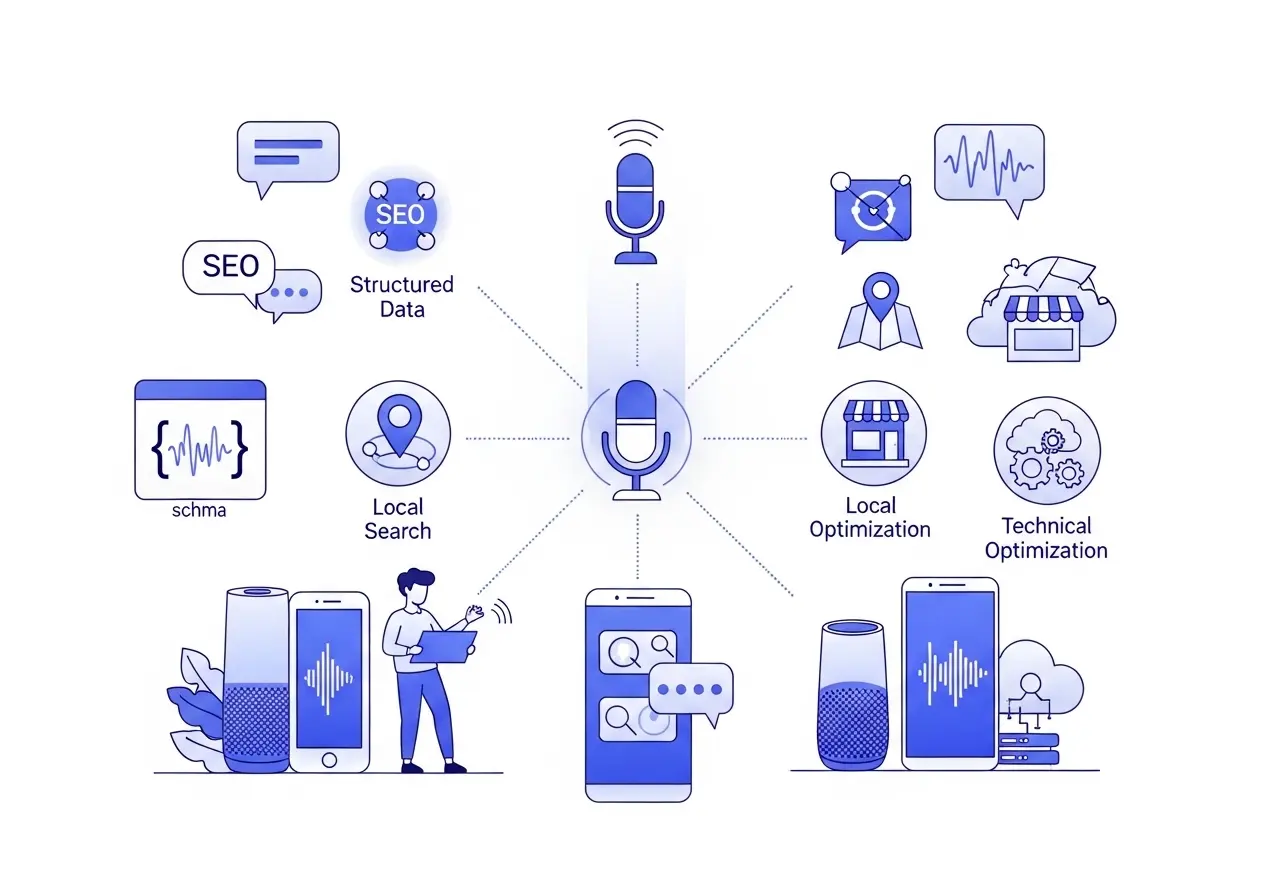
To effectively optimize for voice search, you need more than just keywords. Voice search success relies on a mix of conversational content, smart structuring, technical finesse, and local awareness. Here’s a breakdown of the most impactful elements to help your content get discovered and spoken aloud.
Conversational & Long-Tail Keywords
Use tools like AnswerThePublic, AlsoAsked, and SEMrush’s Question Filters to find voice-friendly queries.
Think like your customer: “How can I improve my website’s speed?” instead of “website speed tips.”
Insert these keywords naturally in titles, headers, and paragraphs without sounding robotic.
Question-Based Phrases
Structure headings around real user questions from Google’s PAA box.
Use “how,” “what,” “why,” “where,” and “can I” phrases.
Provide concise, direct answers immediately after each heading to increase your chances of being the snippet read aloud.
Featured Snippets & Answer Boxes
Format answer paragraphs in 40–50 words.
Use bullet lists, tables, and step-by-step guides.
Optimize content using HTML tags like ol, ul, h2, and p to support snippet formatting.
Schema & Structured Data for Voice
Implement FAQPage, QAPage, and Speakable schema.
Use Google’s Rich Results Test to verify your schema is correctly implemented.
Local SEO & “Near Me” Queries
Claim and optimize your Google Business Profile.
Embed NAP (Name, Address, Phone) data across your website.
Encourage and manage reviews to boost credibility.
Include city-specific landing pages and content.
Mobile & Performance Optimization
Use responsive design to ensure mobile-friendliness.
Improve loading speeds to under 3 seconds.
Test using Google’s PageSpeed Insights or Lighthouse.
Ensure buttons and menus are voice-accessible for screen readers.
Technical SEO Essentials
Use HTTPS, compress images, and remove broken links.
Optimize crawl budget with clean sitemaps and robot.txt files.
Enable lazy loading, reduce JavaScript bloat, and ensure all content is indexable.
Measuring Voice Search Success
Tracking voice SEO performance can be challenging due to attribution gaps, but here are reliable methods:
Monitor “question-style” search queries in Google Search Console.
Look for zero-click searches and featured snippet placements.
Use tools like SEMrush, Moz, or Ahrefs to track voice-optimized keywords.
Evaluate traffic changes on mobile and location-based searches.
Implement event tracking in GA4 for voice-command-friendly pages.
Advanced & Future-Proof Tactics
Multilingual Voice Optimization: Create regionally adapted content using dialects and local languages.
Conversational UX: Integrate voice assistants or chatbots on-site.
Audio SEO: Start optimizing for podcast/audio snippets in voice results.
Zero UI Design: Explore hands-free website navigation and voice-command site interactions.
Common Mistakes to Avoid
Ignoring mobile responsiveness and speed.
Using stiff, unnatural keyword placements.
Failing to update outdated local listings.
Not validating structured data.
Treating voice optimization as a one-time task instead of an evolving process.
Get Ready for the Voice Future
Voice search is reshaping digital discovery. As smart devices evolve and voice becomes the dominant interaction model, your SEO strategy must speak the same language as your users.
Whether you’re targeting local buyers, mobile users, or AI-generated snippets, optimizing for voice search positions your brand to lead in the next wave of digital transformation.
Ready to optimize your website for voice-first search? Connect with EvenDigit today and let’s make your brand the answer they hear.
FAQs
Q1: What is Voice Search Optimization (VSO)?
VSO is the practice of optimizing your content for queries made through voice assistants. It focuses on conversational language, quick answers, and local intent.
Q2: How do I find keywords for voice search?
Use tools like AnswerThePublic, Google PAA, and Ahrefs to identify question-based, long-tail phrases.
Q3: Is voice search the same as regular search?
No. Voice search is more natural, uses full questions, and often targets local, high-intent queries.
Q4: How does schema markup help with voice search?
A schema provides context to search engines. Using the FAQ and Q&A schema increases the chances of being featured in AI-generated voice responses.
Q5: Can I optimize for voice search in regional languages?
Yes. Use region-specific keywords, language schema, and multilingual content to improve visibility.
Q6: What are featured snippets, and how do I target them?
Featured snippets are answer boxes that Google pulls to the top of search results, often read aloud in voice responses. Target them with concise, formatted answers, bullet lists, and schema markup.