
When you Google your main service, page one is dominated by big brands, marketplaces, and directories.
Your product or services are solid. Your reviews are genuine. Yet your site shows up on page two or beyond. It stings. And it costs leads.
The fix is not a bigger budget. It is sharper focus, faster moves, and pages that answer better than theirs. In this guide, we are helping small businesses to learn from big brands.
If you are ready to win the SERPs and your niche, keep reading. We’ll give you a clear playbook, ready-to-use templates, and a 90-day plan you can execute this quarter.

1. Learn from Big Brands: Copy the Moves That Matter
Big brands are not winning by luck. They win because their foundations are clean, their pages are easy to use, and their data is machine-readable. Copy these habits first. They make every other SEO step work better.
Technical hygiene checklist
- Keep pages fast and stable. Aim to pass Core Web Vitals for LCP, INP, and CLS so users see content quickly and interactions feel smooth.
- Design mobile first. Use a responsive layout, readable fonts, and tappable buttons so the site works perfectly on phones.
- Make crawling simple. Submit an XML sitemap, keep robots.txt clean, and remove dead ends so Google can discover and index the right pages.
- Control duplicates. Use canonical tags, correct redirects, and a single preferred URL for each page so equity is not split.
- Serve everything over HTTPS. Secure pages protect users and prevent browser warnings that hurt trust.
- Fix obvious errors. Resolve broken links, missing titles, and thin meta descriptions so search results look complete and clickable.
UX that reduces bounce
- Guide visitors with clear navigation. Group services logically and keep labels simple so people find what they came for in one or two clicks.
- Write for scanners. Use short paragraphs, helpful subheadings, and clear summaries so busy readers get answers fast.
- Link with purpose. Add internal links that move users to related answers, service pages, or next steps instead of sending them back to search.
- Keep forms light. Ask only for what you need and show trust signals near CTAs so more visitors complete the action.
- Remove friction. Cut pop-ups that block content, fix layout shifts, and ensure images load in the right size for the device.
Structured data basics
- Add a schema that matches the page. Use LocalBusiness on location pages, Service or Product on offer pages, FAQPage for real FAQs, and HowTo for step lists.
- Keep markup truthful. Make sure structured data reflects the visible text and numbers on the page to avoid confusion or penalties.
- Mark up contact details. Include business name, address, phone, hours, and links so Google can confirm who you are and where you operate.
- Validate before shipping. Test with a structured data tool and fix warnings so search engines can parse your content correctly.
- Update when pages change. Refresh the schema whenever you edit copy, pricing, hours, or FAQs so the data never drifts from the page.
2. Win Where Big Brands Are Slow
Big players chase head terms. You will win by going specific, going local, and shipping faster. Copy these habits and move before they do.
Own the long-tail
- Target precise, commercial phrases your buyer actually types. “Emergency AC repair in Indore” beats “AC repair.”
- Map one intent to one page. Answer the exact question, then show the next step.
- Use a simple flow: list seed topics, mine autocomplete and People Also Ask, sanity-check difficulty, draft an answer-first outline, then publish.
- Add one clear example per page so the advice looks real, not generic.
Go local on purpose
- Fully complete your Google Business Profile with accurate NAP, categories, hours, photos, and services.
- Ask for reviews weekly and reply to each with a short, personal note.
- Create a dedicated location page for each priority city with local proof, FAQs, and a strong CTA.
- Keep citations consistent across major directories so Google trusts your details.
Speed to publish
- Work in weekly sprints. Brief on Monday, draft Wednesday, review Thursday, publish Friday.
- Give each page a single owner so decisions happen fast.
- Iterate from data. Check Search Console weekly, refresh titles and intros, and add missing subtopics.
- Keep a simple calendar so you never stop shipping.
3. Start Adapting Google AI Shift
Google surfaces more answer summaries. That rewards pages that are clear, credible, and easy to parse. Build for humans first, then for machines that read like humans.
Build answer-first pages
- Lead with a two-sentence answer at the top. Expand with steps, visuals, and sources below.
- Keep key points in text so Google can extract them cleanly.
- Use plain language that your customer understands.
Structure for AI surfaces
- Use clear H2 and H3 headings that mirror how people ask.
- Add short FAQs and how-to steps that help with the task.
- Mark up only what the page actually shows. Keep the schema accurate.
EEAT and entity signals
- Add real bylines, credentials, and a short author bio.
- Show who you are and where you operate with a clean About and Contact.
- Add first-hand proof like photos, licenses, or mini case numbers.
Avoid scaled-content traps
- Do not mass-produce near-duplicate pages to chase every variation.
- Publish fewer, better pages with a clear purpose and unique value.
- Consolidate thin pages into a stronger, single resource.
Measure in reality
- Track performance in Search Console under Web. Watch landing pages, queries, and CTR.
- Compare before and after for titles, intros, and added FAQs.
- Follow conversions, not just clicks, so you see business impact.
4. Build Authority the Practical Way
You do not need thousands of links. You need the right mentions from the right places. Pair each ask with something worth citing.
Link outreach ladder
- Start with partners and suppliers. Offer a joint tip sheet or a short case mention that they can publish.
- Pitch chambers and associations with a helpful guide for their members.
- Share a local angle with community news or radio. Keep it useful, not promotional.
- Reach niche blogs and resource pages with a small tool, checklist, or comparison that they can reference.
- Keep outreach short, personal, and relevant. One clear ask per email.
Content that earns citations
- Publish comparisons with clear recommendations and reasons.
- Create checklists and calculators that save time for the reader.
- Write step-by-step guides with current screenshots or photos.
- Share small data snippets or pricing ranges from real work.
- Tell short case stories with outcomes and numbers.
Review engine
- Ask after delivery with a simple link and two-line prompt.
- Respond to every review with gratitude and one specific detail.
- Feature a few reviews on key pages near CTAs.
- Track review velocity monthly so the flow stays healthy.
5. Turn Rankings into Revenue
Traffic without action is vanity. Shape your pages to answer fast, build trust, and make the next step obvious on every device.
Page models that convert
Templates remove guesswork. Match search intent, answer fast, then guide the next step with trust signals and clear CTAs.
Service page anatomy
- Open with the problem you solve and who you help.
- Prove credibility with logos, ratings, or certifications.
- Explain the offer and benefits in plain words.
- Show your process in three to five steps so it feels easy.
- Close with concise FAQs and a primary CTA.
City or location page anatomy
- Localized intro that ties your service to the city.
- List services available in that location with short blurbs.
- Add a map, NAP, hours, and service area notes.
- Include local photos and a few recent reviews.
- End with city-specific FAQs and a strong CTA.
Definitive guide to anatomy
- Start with an answer-first summary box.
- Walk through steps with images or short clips.
- Add a mini case story with numbers.
- Finish with a checklist, FAQs, and next steps.
Micro-CTAs that move action
- Use click-to-call on mobile and keep it above the fold.
- Offer a short quote form with only essential fields.
- Add a light lead magnet like “Get a price range” or “Download checklist.”
- Keep CTAs visible as users scroll without blocking content.
Tracking basics
- Set GA4 events for form submits, calls, and WhatsApp clicks.
- Route all thank-you pages to clean URLs you can measure.
- Tag GBP links with UTMs so local clicks are visible.
- Review assisted conversions so you see the full impact of organic.
SEO Playbook and Checklists for Small Businesses
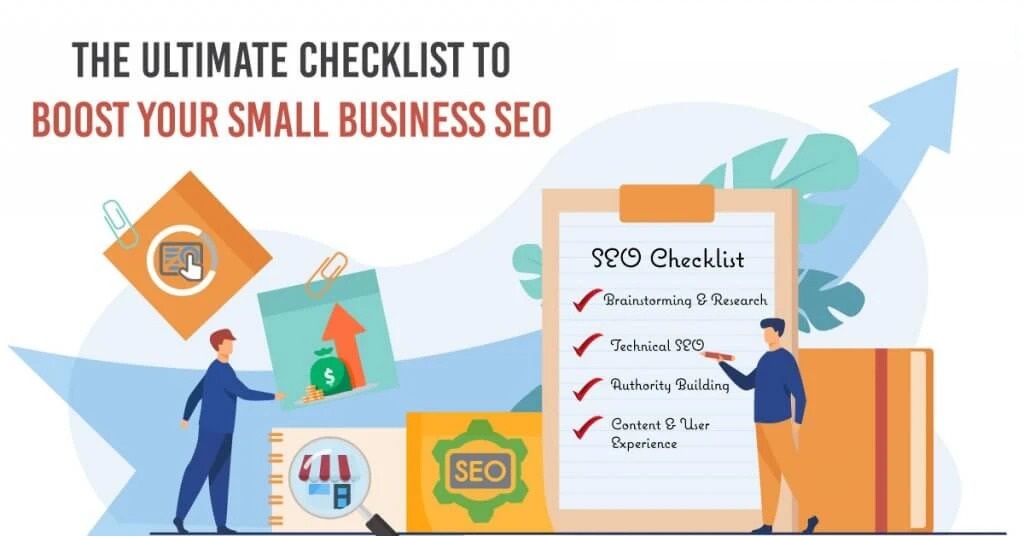
These are your “do this now” guides. No theory. Each playbook is a mini SOP you can follow step by step. Share it with your team. Check items top to bottom, and you will ship clean pages faster.
Local SEO Checklist: 10-Point Starter
- Claim and verify Google Business Profile
- Pick the correct primary and secondary categories
- Add description, hours, services, and service area
- Upload 10+ quality photos and 1 short video
- Answer GBP Q&A and post an update weekly
- Audit NAP across major directories. Fix mismatches
- Set a weekly review request cadence. Reply to all
- Add UTM tags to GBP buttons to track clicks
- Create a city page for each priority location
- Track calls, direction requests, and site visits in GBP
Long-Tail Keyword Research Checklist: 30-Minute Method
- List 3 seed topics per service
- Mine Google Autocomplete and People Also Ask for exact phrasing
- Keep only buyer or problem-solver intents
- Sanity-check difficulty with any basic tool
- Draft an answer-first outline with 3 subheads
- Add one real example or mini case
- Recheck in Search Console. Add missing subtopics
Technical SEO Checklist: 10-Point Health Check
- LCP, INP, CLS in the green on key pages
- Responsive layout. Fonts readable on mobile
- One canonical URL per page
- Valid XML sitemap submitted in Search Console
- txt allows important paths
- No broken links or 404 loops
- Titles and meta descriptions are unique and useful
- Relevant schema that matches visible content
- HTTPS everywhere. No mixed content
- Image sizes and lazy-loading are set correctly
Internal Linking Playbook
- Pick one service. Map a cluster:
Definition → Guide → Checklist → City page → Case story
- Link both ways inside the cluster
- Use natural anchors that match intent
- Add 1–2 links from older posts to each new page
- Request indexing in Search Console. Monitor coverage and clicks
Content Promotion Checklist
Publishing is half the job. Promotion turns a good page into clicks, links, and leads. Use this checklist to seed your content with partners, local media, and your own channels so it gets discovered fast and keeps earning citations over time.
Before publish
- Tell one partner and one association about the upcoming guide
- Offer a quote or data snippet they can feature
After publish
- Share in your newsletter with a single CTA
- Post one tip from the guide on GBP and link to the page
- Pitch one local journalist with a community angle
- Submit to one relevant resource page or directory
30–60–90 Day SEO Roadmap for Small Businesses
This is your step-by-step plan to rank faster with limited resources. Typical minimum impact with consistent execution: early long-tail impressions and clicks in 4–8 weeks, visible lift in GBP actions, and first top-20 entries by day 60.
By day 90, expect multiple long-tail top-10s and a clear uptick in qualified leads. Results vary by market and effort. Trend up is the goal.
Days 1–30: Ship your cornerstone
- Publish 1 service page, 1 city page, 1 definitive guide. Lead with answer-first intros.
- Complete Google Business Profile. Set review request cadence.
- Fix Core Web Vitals on key pages. Submit XML sitemap. Clean robots.txt.
- Map internal links across the new cluster.
- Set GA4 events for forms and calls. Add UTM to GBP buttons.
Expected minimum impact: Indexing confirmed. New impressions for long-tails. More calls, website clicks, and direction requests from GBP.
Days 31–60: Add depth and proof
- Publish 3–4 support posts targeting specific problems and questions.
- Add checklists, mini data points, or screenshots to each post.
- Secure 3–5 local links from partners, associations, or resource pages.
- Post weekly updates and photos on GBP. Reply to all reviews.
- Refresh titles and first paragraphs on underperforming pages.
Expected minimum impact: Several target queries enter the top-20. 20–40% growth in impressions. Noticeable CTR lift on refreshed pages. First organic enquiries.
Days 61–90: Promote and refine
- Pitch 5–10 local or niche outlets with a useful angle or data snippet.
- Consolidate thin pages. Expand winning pages with missing subtopics.
- Strengthen internal links between definition, guide, checklist, city, and case pages.
- Test conversion elements. Shorter forms. Clearer CTAs. Click-to-call on mobile.
Expected minimum impact: Multiple long-tails in top-10. Higher GBP actions. 15–30% lift in organic leads vs baseline, assuming consistent execution.
SEO Metrics That Move Rankings and Revenue
Track what proves progress. These metrics show if your SEO is working, where to double down, and what to fix next.
Search visibility
- Impressions (Search Console): Are you being seen for more queries?
- Clicks and CTR: Are your titles and intros earning the click?
- Average position: Movement across keywords and pages.
- Top 3 / Top 10 keywords: Count and trend by page and cluster.
- New queries gained: Net-new terms where you now appear.
- Local Pack visibility: Map rankings and appearances for target terms.
Engagement and content performance
- Engaged sessions (GA4): Sessions with meaningful time or actions.
- Average engagement time per page: Are readers staying to consume?
- Scroll depth: Do users reach key CTAs and FAQs?
- Exit rate by section: Which pages lose interest?
- SERP-to-page match: Does the page answer what the query promised?
Technical health
- Core Web Vitals: LCP, INP, CLS pass rate across key pages.
- Index coverage: Indexed vs submitted, exclusions, soft 404s.
- Crawl stats: Crawl rate, response times, server errors.
- Mobile usability: Layout, tap targets, viewport issues.
- Canonical accuracy: One preferred URL per page.
- Structured data validity: Errors and warnings by template.
Authority and trust
- Referring domains: Number and relevance of linking sites.
- Link velocity: Quality links earned month over month.
- Anchor diversity: Natural language, topical fit.
- Brand mentions: Unlinked citations you can convert to links.
- Content citations: External sites quoting your guides or data.
Local SEO signals
- GBP actions: Calls, direction requests, website clicks, messages.
- Reviews: Count, average rating, review velocity, response rate.
- Photo views and updates: Freshness and engagement on GBP.
- Category performance: Visibility by chosen categories.
- NAP consistency: Match across major directories and citations.
- Q&A coverage: Questions answered and flagged as helpful.
Conversion and revenue
- Leads from organic: Form submits, calls, chats, and quotes.
- Conversion rate (organic only): By page type and device.
- Assisted conversions: Organic’s role across the funnel.
- Qualified pipeline/revenue from organic: If tracked in CRM.
- CPL and CPA (organic): Cost of content and links vs leads.
- LTV: CAC ratio: Long-term value from organic customers.
Output and efficiency
- Pages shipped per month: Net new and updated.
- Time to publish: Days from brief to live.
- Update cadence: Percent of pages refreshed in the last 90 days.
- Outreach throughput: Emails sent, replies, placements.
- Content hit rate: Percent of new pages reaching the top 20 in 90 days.
Early warning diagnostics
- Spike in 404s or 5xx errors: Fix before rankings dip.
- Duplicate titles or thin pages: Consolidate or expand.
- Sudden CTR drops on winners: Retest titles and intros.
- Indexing stalls on new pages: Inspect, link internally, request indexing.
- Core update impact: Note date, pages affected, and recovery plan.
Simple dashboard blueprint
- Top widget: Clicks, impressions, CTR, average position.
- By cluster: Top 3/10 counts, new queries, page leaders.
- Technical panel: CWV pass rate, indexing errors, schema errors.
- Local panel: GBP actions, reviews, and map rankings.
- Revenue panel: Leads, conversion rate, assisted conversions, CPL.
Ready to Win the SERPs?

You have the roadmap. We have the senior hands to execute it. EvenDigit SEO leadership brings 15+ years of search experience and has guided hundreds of businesses to consistent page-one wins.
We build for today’s AI-led search reality with answer-first pages, entity strength, and clean technical foundations that dominate SERPs. Let’s connect and get your free SEO audit.
Some Frequently Asked Questions
Do reviews impact local rankings?
Yes. Review volume, rating, recency, and your response rate all influence Local Pack visibility. Ask regularly, reply to every review, and keep your Google Business Profile complete and accurate.
How fast can a small business see SEO results?
Early movement on long-tail queries often appears in 4–8 weeks. Stronger gains typically land in 3–6 months, depending on competition, page quality, links, and consistency.
What’s the best first schema to add?
Start with Organization/LocalBusiness so Google understands who you are, where you are, and how to contact you. Then add FAQPage to pages with real FAQs, and Service or Product where relevant.
Do long-tail keywords actually bring sales?
Yes. They capture specific problems and high intent, even with lower volume. Build one page per intent, show the solution clearly, add proof, and include a simple CTA.
Should I create separate pages for each city?
Yes, if you truly serve those locations. Make each page unique with local proof (areas served, photos, reviews, FAQs) and a clear CTA. Avoid thin “doorway” pages.
How many backlinks do I need to rank?
There’s no magic number. Quality and relevance beat quantity. For local pages, even 3–5 strong, topical links plus solid internal links can move rankings; keep earning them steadily.
What is “answer-first” content?
You open with the two-sentence answer at the top, then expand with steps, visuals, and sources. It helps users decide fast and makes your page easier for Google’s AI features to cite.
How often should I update my Google Business Profile?
Weekly is a good cadence. Keep hours, services, and photos current, post short updates, answer Q&A, and respond to reviews within 24–48 hours.