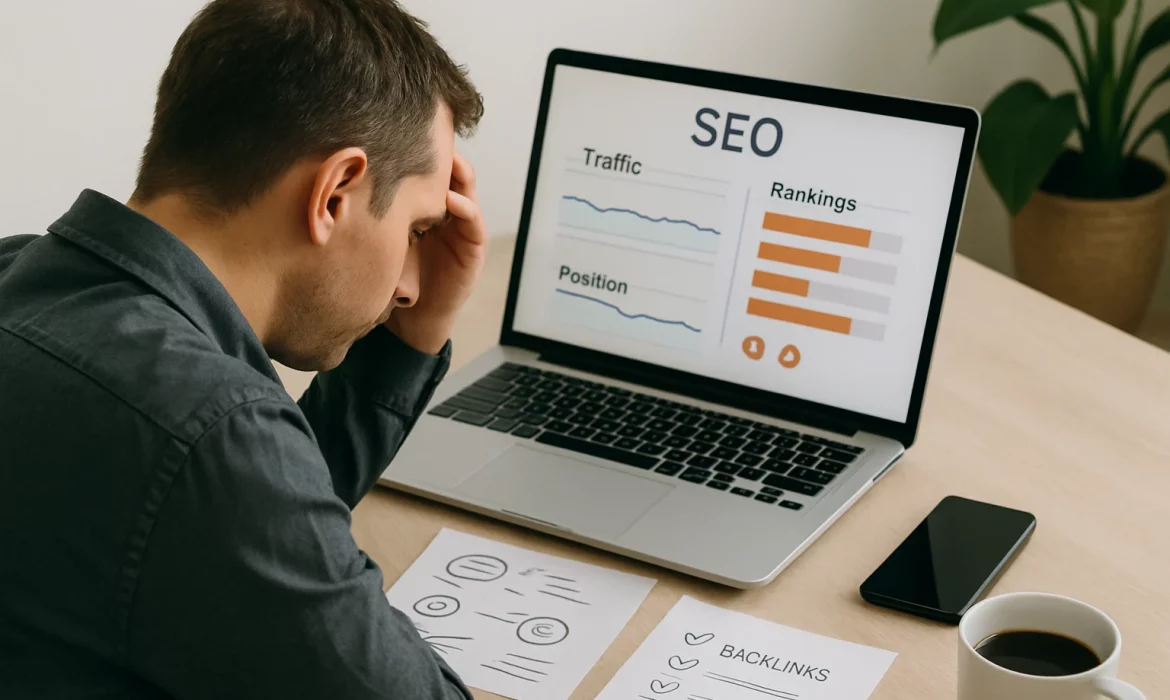
You’ve spent hours on SEO tweaks. Upgraded title tags. Built backlinks. Yet your traffic barely moves.
It feels like you’re stuck. You know SEO matters. You’ve tried the basics. Still, nothing changes.

Just like 91% of websites don’t get any organic search traffic from Google. The reason? Because they are not properly SEO optimized.
Your website is just missing pro-level SEO practices…So, let’s get that missing piece.
When It’s Time to Get Expert Help to Improve SEO?
If you’ve been stuck on page three or four for weeks, that’s a sign. If your organic visits aren’t climbing, that’s a red flag. If you pour hours into SEO but see zero gain, you need an expert’s eyes.
Here are some clear signs you need an SEO pro:
- Stuck or Falling Traffic: Your site isn’t climbing the rankings for key terms. Month after month, visits hover or drop.
- Major Site Changes: You’ve redesigned your site or migrated to a new platform. Without an SEO playbook, you risk broken redirects and lost URLs.
- No In-House Bandwidth: Your team is swamped. You simply don’t have time to hunt down crawl errors, tweak metadata, or research the latest algorithm shifts.
- Lack of Deep Expertise: SEO isn’t just keyword lists. It’s complex, think of structured data, JavaScript rendering, and local search. If you haven’t mastered these, you’re missing out.
- Aggressive Growth Goals: You’re entering new markets or niches. Localized strategies, multilingual SEO, and advanced keyword mapping enable experts to fast-track your expansion.
- Fierce Competition: Competitors have moved ahead. They show up for searches you once owned. You need a fresh, data-driven edge to catch up.
- Keeping Pace with Google: Algorithms change constantly. If you can’t stay on top of updates, you’ll fall behind. Experts live in that world every day.
11 Expert Strategies to Instantly Boost Your SEO

Until you connect and get started with experts, use these tactics to kick your SEO back into gear.
1. Run a quick content audit.
Grab your analytics and a site-crawler tool. Pull every URL, then sort by organic traffic and engagement.
Ask: which pages barely get visits, or see people bounce in under ten seconds? Those are your “thin” pages. Merge or prune them.
Then, flag your top performers. Can you update them with new stats or fresh examples? It sounds tedious, but when a bloated site ditches dead weight and becomes lean, Google notices. And readers stay longer because every page earns its spot.
2. Map every page to real search intent.
Search intent isn’t just a buzzword. It’s why someone types a question. So for each target keyword, peek at the current SERP.
Are the results a how-to, a product page, or a directory? If your “best SEO tools” blog reads like an overview but the SERP shows comparison charts, you’re mismatched. Tweak your format, add tables, or step-by-step instructions. Or pivot the topic.
When your content lines up with what users actually want, dwell time climbs and bounce drops.
3. Supercharge page speed and Core Web Vitals.
Open PageSpeed Insights now. Check your Largest Contentful Paint, First Input Delay, and Cumulative Layout Shift scores. If images are uncompressed or fonts block rendering, fix them. Lazy-load below-the-fold media. Cut unused JavaScript.
A two-second improvement in LCP can lift conversions by double digits. Google’s making these metrics central to ranking, so every millisecond counts. It’s granular and technical, yes, but the payoff is immediate.
4. Live by mobile-first design.
Flip your laptop to mobile preview. If you pinch-zoom or accidentally tap the wrong link, your mobile UX is broken. Remember, Google crawls the mobile version first.
Use responsive grids and fluid images so your layout adapts. Check touch targets; links need thumb-sized tap zones. And if your desktop navigation hides in a cramped hamburger menu on mobile, rethink it.
A smooth phone experience keeps users from bouncing, and tells Google your site deserves top placement.
5. Add the right structured data.
You don’t need a full-blown schema.org library. Start with the FAQ and HowTo markup on key pages. Drop a simple JSON-LD snippet into your header.
Then test it in Google’s Rich Results tool. If everything passes, search results can show your content as collapsible FAQs or step lists.
That extra real estate can boost click-through by up to 30 percent. It’s a small code tweak that signals Google exactly what your page covers, and makes your snippet stand out.
6. Build a strategic internal link network.
Once your content pillars and clusters are set, weave them together. Go in and add three or four contextual links on each page, link from your main “SEO framework” guide to your “keyword research deep dive,” and back again.
Use descriptive anchor text that matches the target page’s keyword. Not only does this help readers discover related content, but it also spreads “link equity” across your site.
When Googlebot follows those links, it sees your topic clusters as coherent hubs of authority.
7. Hunt down broken link opportunities.
Broken link building is almost under the radar, but it works. Use a link-checker or Ahrefs to find external resource pages in your niche or industry with dead links.
Then reach out, hey, I noticed you linked to an old blog post that’s gone 404. Here’s a fresher guide you might use.
It’s human, it’s helpful, and you earn a new high-quality backlink. You’re solving someone else’s problem while growing your profile. Simple outreach, big impact.
8. Optimize for local SEO even if you’re global.
Local signals matter, even if you ship worldwide. If you have offices or service areas, claim your Google Business Profile.
Add up-to-date hours, photos, and posts. Sprinkle local keywords, “SEO consultant in Denver,” into your service pages. Make sure your NAP (name, address, phone) is consistent across directories.
When Google sees those matches, you can rank in the local pack and capture highly motivated searchers.
9. Sharpen your user experience.
Stuff it with fancy animations and you’ll confuse people. Instead, keep navigation clear, main menu items under five, breadcrumbs on deep pages, and a visible search bar.
Break text into short paragraphs, use descriptive subheaders, and add jump links for long articles. No one wants a wall of text.
And if you slip in a related post link after a key insight, like “Want the full SEO audit checklist? Click here,” you’ll keep readers on your site longer. Those behavioral signals matter.
10. Dress your content for voice and AI search.
People talk differently to Alexa than they type into Google. They ask complete questions, “Hey Google, what’s the best SEO audit tool?” So write conversational headers like that. Test FAQs in your content and see if you can nab a voice snippet.
11. Treat data as your north star.
Log in to Search Console every week. Spot pages that get lots of impressions but low clicks, maybe their titles need a spark.
Find queries where you hover around position 8 or 9, could you tweak the content to push you into position 3? Watch for crawl errors or mobile issues flagged by GSC. And in Analytics, track bounce rates and time on page.
If a post has low engagement, rework it or merge it with something stronger. SEO isn’t set and forget. It’s constant iteration fueled by real metrics.
DIY SEO vs Expert for SEO: Which One Does Your Website Need?

Deciding between DIY SEO and expert help? It all starts with your goals and your bandwidth. The right choice hinges on what you need and the resources you can commit. Here are five factors to guide you:
1. Decide your goals first.
Are you gunning for quick wins or building a long-term lead magnet? If you want to own page one and stay there, you’ll need expert help. DIY can tweak basics, but real visibility and authority demand pros who live and breathe SEO.
2. Think about your budget.
Sure, hiring two or three in-house folks sounds cost-effective. But experience matters. Experts know what actually moves the needle; they don’t waste time shooting in the dark.
At an agency, strategists, executioners, and content writers work together. You get high-quality work without juggling a dozen freelancers.
3. Consider the complexity of your site.
A simple blog? You might manage with DIY tools. But a multi-language ecommerce platform or a big site migration is a beast. Experts have been there. They’ve fixed the crawl errors you haven’t even spotted yet.
4. Evaluate your time and bandwidth.
SEO isn’t a one-off task. It’s a constant grind of audits, link outreach, and content updates. Do you really have hours every week to dedicate? If your team is slammed with product launches or support tickets, that’s a recipe for stalled SEO.
5. Look at your growth ambitions.
Expanding into new markets or niches means you need localized strategies, keyword research at scale, and competitive intel. Pros already have those playbooks. They help you enter markets faster and smarter, with no guesswork.
Get a Free Website Audit From SEO Experts
EvenDigit is a leading SEO agency. Our team has guided hundreds of websites to higher organic traffic and stronger search rankings. It’s time to see exactly where your SEO is falling short. Claim your free audit today, and we’ll pinpoint the gaps holding you back.
We begin with a comprehensive site review. Our experts examine your content quality, sitemap setup, backlink profile, competitor landscape, and every technical detail that matters. From page speed to metadata, we leave nothing unchecked.
Once the audit is complete, we sit down with you to discuss the results. Together, we map out a plan aligned with your goals, whether that is more leads, wider visibility, or lasting authority. After you approve the strategy, our team gets to work.
As we roll out those improvements, you’ll start to see persistent gains in rankings and traffic. That marks the beginning of your next chapter in online success. Get your free audit now and let us build the SEO roadmap you need.