Summary:
Generative Engine Optimization (GEO) is redefining digital visibility. Unlike traditional SEO, which focuses on ranking web pages, GEO concentrates on earning citations and visibility within AI-generated search results. This guide breaks down GEO vs SEO, the evolution of AI-driven SEO strategies, and how to future-proof your content for the next generation of search.
Introduction: The New Face of Search
Search is evolving from blue links to conversational summaries. With Google’s AI Overviews, ChatGPT, and Perplexity delivering instant synthesized answers, clicks are no longer the only measure of success.
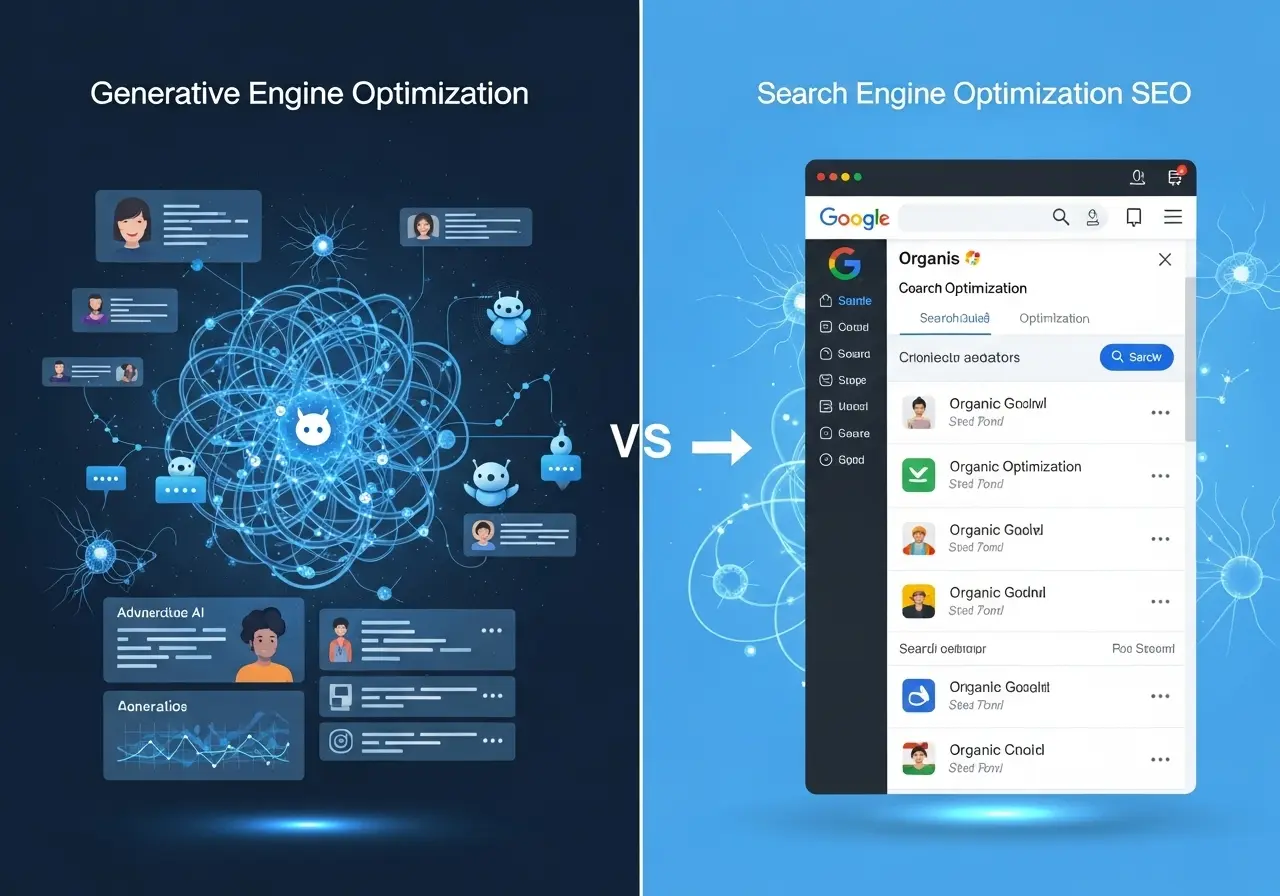
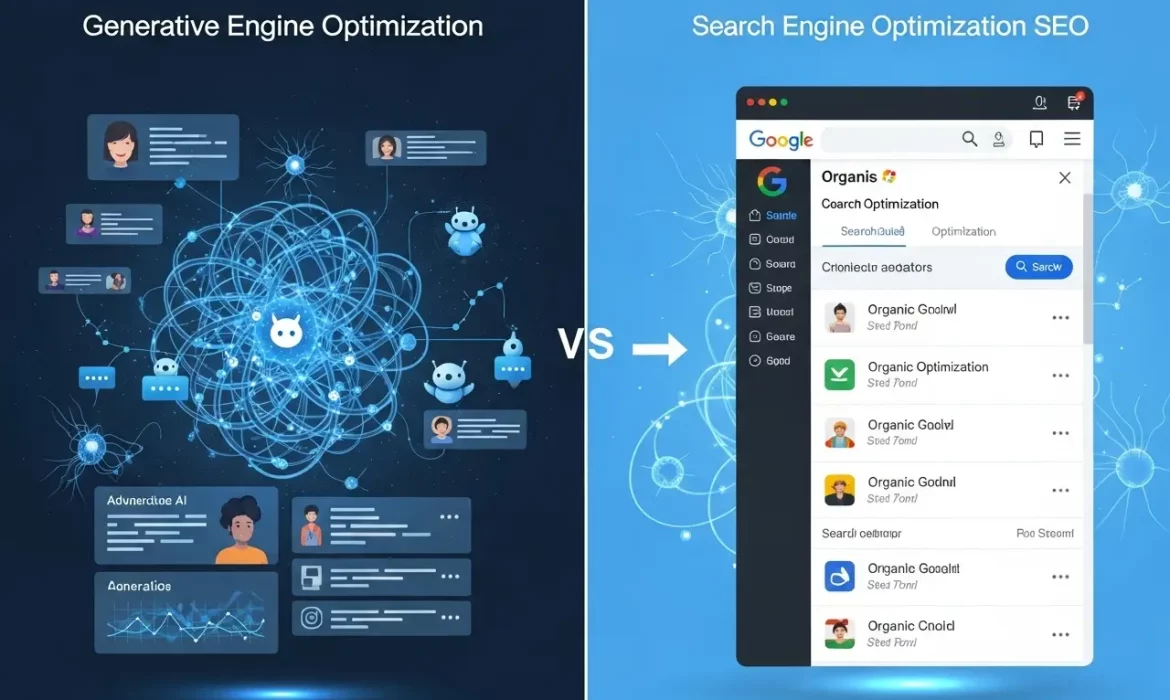
If SEO made you rank, GEO makes you referenced. Let’s understand how this shift changes everything about content strategy.
What Is Generative Engine Optimization?
Generative Engine Optimization (GEO) is the process of optimizing your content to appear in AI-generated responses. Instead of targeting only crawlers and SERPs, GEO ensures your brand’s insights are cited in AI summaries.
It focuses on clarity, credibility, and context, the qualities AI models value most when curating trustworthy answers.
GEO vs SEO: Understanding the Differences
Here’s a snapshot of how traditional SEO and GEO diverge and where they overlap.
| Aspect | Traditional SEO | Generative Engine Optimization (GEO) |
|---|---|---|
| Goal | Rank pages on SERPs and drive clicks | Earn citations in AI-generated answers |
| Focus | Keywords, backlinks, and technical SEO | Entities, clarity, structure, and E-E-A-T |
| User Intent | Transactional and navigational | Conversational and informational |
| Format Preference | Long-form articles | Structured Q&A, tables, and summaries |
| Metrics | Rankings, CTR, sessions | Citation frequency, AI share of voice |
| Tools | Google Search Console, Ahrefs | Perplexity, ChatGPT, and AI citation trackers |
| Search Interface | “10 blue links” | Conversational summaries and snippets |
Key takeaway:
GEO doesn’t replace SEO; it evolves it. You still need strong SEO foundations, but GEO adds an AI-first lens to make your content discoverable in generative engines.
The Future of SEO in an AI-Driven Search Landscape
AI-driven search is transforming the way users interact with information. Here’s what’s changing:
- Zero-click dominance: Fewer users are visiting websites, as AI provides direct answers.
- Intent-first optimization: Queries are longer and more conversational, mirroring natural speech.
- Entity understanding: Google and AI models now rank concepts, not just keywords.
- Authority dispersion: Citations, brand mentions, and context-rich credibility weigh more than backlinks.
- Cross-channel impact: AI pulls from YouTube, Reddit, forums, and PDFs, not just blogs.
To stay visible, your SEO strategy must evolve from keyword density to intent fulfillment.
AI-Driven SEO Strategies for GEO Success

AI-driven SEO strategies integrate structured writing, entity-based optimization, and factual transparency.
Here’s how to prepare your content for both crawlers and conversational models.
1. Build Topic Clusters Around Entities
- Identify your key entities (products, people, industries).
- Create pillar pages that define them and cluster supporting content around each.
- Use semantic links to signal relationships between topics.
2. Structure Content for AI Comprehension
- Lead with concise, fact-based answers.
- Use headers (H2s/H3s), lists, and short paragraphs for clarity.
- Include tables, comparison charts, and checklists to help AI summarize.
3. Implement Schema Markup
- Add FAQPage, Article, and Organization schema.
- Validate through Google’s Rich Results Test.
- Update structured data when content changes.
4. Show E-E-A-T (Experience, Expertise, Authoritativeness, Trustworthiness)
- Add author bios, sources, and publication dates.
- Reference credible external sources.
- Keep tone factual yet human, signaling reliability.
5. Optimize for Conversational Queries
- Use natural question formats like “How does…” or “What is…”
- Analyze “People Also Ask” and “AI Overview” questions for inspiration.
- Craft answers in clear, complete sentences.
Technical SEO Foundations That Still Matter
Even in a GEO-first world, technical SEO remains the foundation.
Focus on:
- Core Web Vitals: Fast load times, mobile optimization, and stable layouts.
- Crawlability: Clean sitemaps, robots.txt management, and proper canonical tags.
- Internal Linking: Use topic-driven linking to guide crawlers and strengthen authority.
- Accessibility: Include alt text, transcripts, and descriptive anchors for inclusivity.
These fundamentals ensure both search bots and AI engines can index your content effectively.
Content Formats That Work Best for Generative Engine Optimization
AI models prefer clarity and structure. Here’s what works:
1. Definition Blocks
Provide short, precise definitions near the start of your content.
Example:
“GEO (Generative Engine Optimization) is the strategy of making content recognizable, structured, and trustworthy for AI models that generate summaries.”
2. Comparison Tables
Summarize differences or similarities visually. AI often cites these for accuracy.
3. FAQS Sections
Add schema-backed FAQs with conversational phrasing.
4. Listicles and Step-by-Step Guides
Structured steps make it easier for AI to summarize process-based content.
5. Mini Case Studies
Include proof points, data, and examples that showcase expertise.
Beyond SEO: Distributing GEO Signals Across the Web
AI learns from diverse sources, not just your website. To strengthen GEO performance:
- Publish on high-authority domains like Medium or Substack.
- Engage on Reddit, Quora, and LinkedIn to appear in LLM training data.
- Collaborate with journalists to get mentioned on news outlets.
- Embed YouTube videos and transcripts to give AI multimodal signals.
A wider footprint improves your visibility in AI-generated results.
How to Measure GEO Success?
Traditional SEO uses traffic-based metrics. GEO introduces influence-based ones.
| Metric Type | SEO | GEO |
|---|---|---|
| Visibility | SERP ranking position | Presence in AI overviews and chatbots |
| Engagement | Clicks, dwell time | Brand mentions, citations |
| Trust | Backlinks and domain authority | Source authority and factual reliability |
| Performance Tools | GA4, Search Console | Perplexity trackers, AI citation monitors |
To measure GEO impact, monitor AI citations manually, or use emerging tools like BrightEdge Generative Reporting and Writer.com Insights.
Implementation Roadmap for GEO and SEO Integration
- Audit: Review content for clarity, structure, and factual depth.
- Map Entities: Identify key topics and build content clusters.
- Add Schema: Ensure proper structured data and FAQs.
- Cite Sources: Include credible links and author bios.
- Monitor: Track AI citations monthly and refresh outdated information.
This roadmap blends traditional SEO and GEO into a single, adaptive strategy.
Governance, Accuracy, and Ethical SEO
AI-generated summaries rely on your credibility.
Maintain trust by:
- Fact-checking all claims and data.
- Updating content regularly.
- Citing verifiable sources.
- Avoiding manipulative or misleading AI prompts.
In GEO, trust is the new backlink.
Common Pitfalls to Avoid
- Over-optimizing for AI without considering human readers.
- Ignoring schema or structured formats.
- Producing thin content without depth.
- Failing to maintain E-E-A-T and factual consistency.
Balance optimization with authenticity to avoid penalties and irrelevance.
Partner With EvenDigit to Build Future-Ready SEO and GEO Strategies
Generative search is no longer optional; it’s the new frontier. At EvenDigit, we combine traditional SEO precision with GEO innovation.
Our SEO experts optimize your content for both SERP rankings and AI citations, ensuring your brand remains visible, trusted, and discoverable across every channel. Let’s make your brand not just searchable, but unmissable.
FAQs
What is Generative Engine Optimization (GEO)?
GEO is the approach of optimizing content to appear in AI-generated search responses from tools like Google Gemini and ChatGPT.
How is GEO different from SEO?
SEO focuses on ranking web pages, while GEO focuses on being cited by AI models in conversational answers.
Does GEO replace SEO?
No. GEO complements SEO by extending your visibility beyond search pages into AI-generated overviews.
How do I measure GEO success?
Track citations in AI responses, brand mentions, and AI share of voice alongside traditional SEO metrics.
What type of content works best for GEO?
Structured, concise, and credible content, especially FAQs, tables, lists, and definitions.