
Google’s AI Overviews have shifted the way users interact with search results. If your ad strategy hasn’t evolved with it, you’re already behind.
In a world where AI-generated summaries now dominate the top of the SERP, the traditional approach of spending money on “top-of-page” visibility is not only outdated but also inefficient.
Brands are losing visibility, CTRs are dipping, and competition for high-intent clicks is climbing. Yet, this isn’t a doomsday scenario. It’s a strategic opportunity if you know how to play it right.

At EvenDigit, we’ve been reworking Google Ads strategies across industries to thrive in this AI-first landscape. And we’re about to show you exactly what’s changed, why it matters, and how you can protect and grow your performance in 2025 and beyond.
The Big Disruption: What AI Overviews Mean for Google Ads
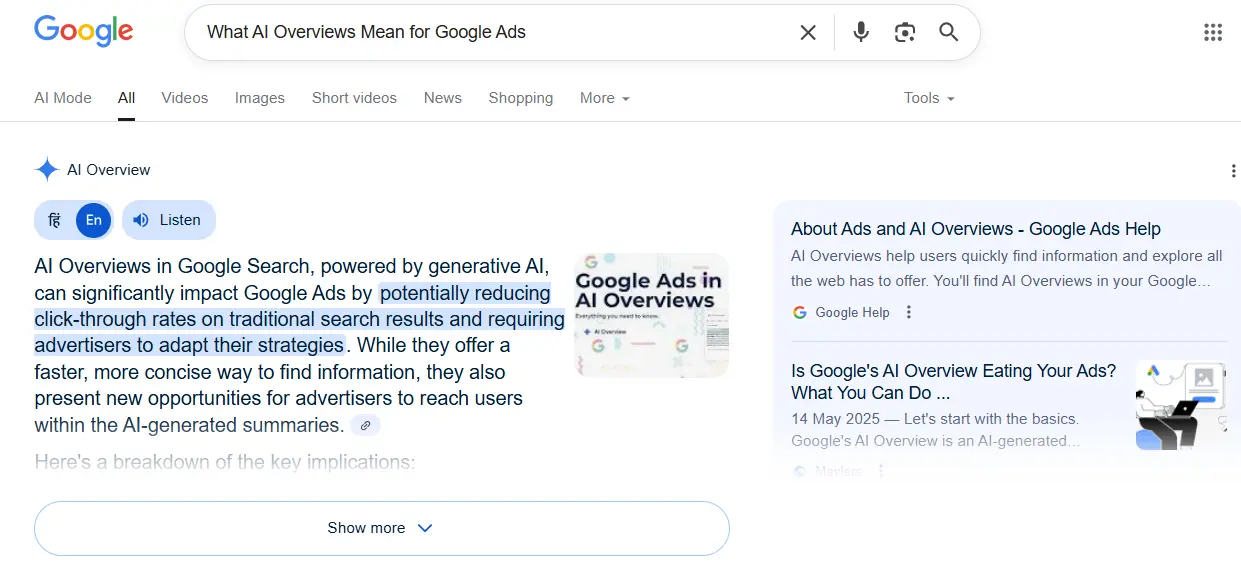
Google’s AI Overviews are fundamentally rewiring how people interact with search. These generative summaries sit at the top of the results page, providing quick answers that often eliminate the need for users to scroll further or click on an ad.
This has three major consequences:
- Your CTRs are falling even when impressions stay the same.
- Your ads are being pushed down the page.
- Your budget is working harder just to maintain the same outcomes.
In fact, early industry studies show that when AI Overviews are triggered, paid ad click-through rates can drop by up to 18%. That’s not a small shift. That’s a warning sign.
But the threat isn’t just visibility. It’s misalignment. Most ad budgets are still calibrated for the old SERP, where search ads used to live at the top and clicks flowed freely. Today, without adapting to how AI shapes queries and intent, you’re paying premium prices for downgraded placement.
This is why brands are now asking:
- Are we bidding on the right keywords?
- Is our campaign structure aligned with new user behavior?
- Are we optimizing for ROI or just burning cash to chase impressions?
You need answers. And more importantly, you need a strategy shift.
The New Reality: Why Your Current Budget Strategy May Be Outdated

Google’s AI-driven changes are hitting advertisers hard. If you’re still using the same budget strategy as you did last year, you’re already falling behind. With AI Overviews becoming a standard in Google Search results, your traditional approach to Google Ads is outdated. It’s time to shift focus from a one-size-fits-all strategy to a tailored, intelligent approach.
The False Assumption of “Same Budget = Same Traffic”
For years, the logic was simple: if you allocated more budget to ads, you’d get more traffic. However, with AI Overviews in place, this assumption is being turned on its head.
Even if your ad impressions increase, you’re likely seeing a decline in actual clicks, especially for informational queries. AI Overviews are serving up answers directly at the top, bypassing the need for users to click on ads.
You’re spending more for the same (or less) traffic, and that’s a problem. It’s no longer about bidding more to outbid competitors; it’s about targeting the right type of traffic that converts.
Rising CPCs Due to Reduced Click Pool
With AI Overviews occupying more prime real estate on the SERP, there’s simply less room for ads to get noticed. As a result, CPCs (Cost-Per-Click) are rising as advertisers fight for limited spots.
Even if you increase your budget, you’re still facing higher competition for fewer clicks. The reality is that unless you adjust your strategy, the cost of maintaining visibility will only continue to rise.
The competition has intensified, but that doesn’t mean you have to bow to higher costs. Re-strategizing your budget around high-intent, transactional keywords will keep your CPCs manageable while boosting ROI.
Zero-Click Search Surge and What It Means
AI Overviews are pushing zero-click searches to the forefront. These searches provide quick answers at the top of the SERP, eliminating the need for users to click on anything.
As a result, organic traffic for many businesses is dropping. For advertisers, this means that your traditional “click” model is no longer as effective.
This also signals a shift towards conversions over impressions. If you’re still optimizing for clicks in an era where fewer people are clicking, your approach is misaligned with the way users now interact with search engines.
Why Just Increasing Spend Won’t Solve the Problem Anymore
Throwing more money at Google Ads won’t guarantee better results. You can’t keep inflating your bids in hopes of securing the top spot when the landscape has changed so drastically. The more money you pour into ads, the more you’ll inflate your costs without seeing proportional returns.
Instead of simply increasing your spend, focus on smart bidding strategies, such as Target CPA and Target ROAS, where you can allocate your spend to high-converting keywords.
As AI optimizes your bids, you can see better returns without inflating your costs. It’s about being smarter with your budget, not just bigger.
How AI Overviews Are Rewriting the SERP?
AI Overviews are changing the way users interact with Google Search. These summaries now occupy prime real estate at the top of the page, pushing ads and organic results further down the page. This shift is creating challenges for advertisers, but also new opportunities.
AI Overviews Are Dominating the Top Spot
AI-generated answers are now the first thing users see on the SERP, taking up valuable space that was once reserved for organic listings and ads. This results in reduced visibility for ads, particularly on mobile devices.
Ads Are Pushed Down, Especially on Mobile
On mobile devices, AI Overviews push ads further down or below the fold, reducing their visibility. This means advertisers may see lower engagement with their ads unless they adjust their bidding strategies.
Shopping and PMax Ads Are Embedded in AI Overviews
Google is embedding Performance Max (PMax) and Google Shopping ads directly into AI Overviews, presenting new opportunities as well as challenges. These ads now blend into the content, making it more difficult for users to distinguish between paid and organic results.
Search Ads Compete Against AI Answers
Ads now compete directly with AI-generated answers. If your ads don’t align with user intent or provide immediate answers, they risk being overlooked in favor of AI content. Ads must be direct and relevant to stand out.
7 Budget-Saving Adjustments You Need to Make Now
With the rise of AI Overviews, it’s more crucial than ever to rethink how you allocate your Google Ads budget. Adjusting your strategy to target high-conversion traffic, rather than just increasing spend, will help maintain efficiency and ROI.
1. Prioritize Transactional Over Informational Queries
Focus your budget on transactional keywords where users are closer to converting, not just informational queries that often get overshadowed by AI Overviews. These high-intent searches are less impacted by AI-driven changes.
2. Shift Toward Brand Campaigns for Visibility
As AI Overviews push ads down, consider reallocating more budget toward brand terms. These terms tend to offer higher visibility and lower CPC, as they are less likely to be cannibalized by AI Overviews.
3. Use Smart Bidding to Control CPA, Not Just Clicks
Move away from basic bidding strategies and adopt smart bidding options, such as Target CPA or Target ROAS. This way, you’re focusing your spend on conversions rather than just clicks, improving overall ad efficiency.
4. Focus on High-Quality Ad Creative That AI Can’t Replicate
Craft unique and compelling ad creatives that stand out in the AI-driven landscape. Highlight value that AI can’t provide, like exclusive deals or human interaction, to draw users’ attention away from AI summaries.
5. Diversify Into Shopping & PMax to Gain AI Overview Entry
Google is embedding Shopping and PMax ads into AI Overviews. To capture this opportunity, allocate budget toward these campaigns, which have a higher chance of getting embedded into these AI-generated spots.
6. Reallocate Budget Across Channels Like Meta & YouTube
Don’t put all your budget into Google. Diversify by increasing your spend on platforms like Meta and YouTube, where AI Overviews aren’t as dominant. This way, you get a more balanced reach without relying solely on Google.
7. Test and Measure AIO vs Non-AIO Campaign Performance
It’s essential to continuously test your campaigns in the AIO (AI Overview) and non-AIO environments. Monitor performance to determine if AIO-targeted ads perform differently from non-AIO ads, and adjust your budget allocation accordingly to optimize performance.
What the Data Tells Us — CTR, CPC, and Ad Positioning in the AI Era

The data is clear: AI Overviews are having a measurable impact on ad performance. As AI-generated answers take prime SERP real estate, advertisers are facing lower click-through rates (CTR), increased cost-per-click (CPC), and shifting ad positions. Understanding these transitions will help you adjust your strategy to maintain your ROI.
CTR Drops: What We’re Seeing
As AI Overviews dominate the SERP, traditional ads are pushed down or displaced. Studies show that CTR for paid ads drops significantly when AI Overviews appear.
One industry study reported a drop of up to 40% in CTR compared to ads without AI Overviews.
Ads that were previously in prime positions are now less visible, particularly on mobile, where screen space is even more limited. As a result, your click-through rate is directly impacted, meaning more of your budget is going toward fewer clicks.
CPC Hikes — More Competition, Fewer Clicks
As visibility drops, competition for the remaining clicks increases, leading to higher CPCs. This is especially true for keywords affected by AI Overviews, where advertisers are competing for more expensive clicks with fewer opportunities.
You may notice CPC inflation of 12-25% across industries such as e-commerce and local services, as advertisers compete for limited prime spots.
Shifting Ad Positions: AI vs Paid Ads
Google’s AI Overviews are now occupying the top of the page, pushing paid ads further down. While this change may seem minor, it’s significant for ad performance.
For example, ads previously positioned at the top of the fold are now further down the page, and in some cases, below the fold on mobile devices. This leads to reduced visibility, especially if your ads are not closely aligned with the queries that trigger AI Overviews.
Are You Still Measuring the Right Things?
As AI Overviews change the landscape, traditional KPIs like impressions and click-through rates (CTR) are no longer “the only” indicators of success.
The focus now needs to shift toward quality traffic and conversion metrics, ensuring that your Google Ads strategy is aligned with the new reality of AI-enhanced search results.
Old KPIs: Impressions, CTR, and Average Position — Now Outdated
For years, advertisers have relied on impressions, CTR, and average position as the core KPIs for measuring Google Ads success. These metrics no longer reflect true performance, especially with AI Overviews dominating the top SERP spots.
Impressions can be misleading, as ads can still receive high impressions but low engagement if they are pushed down the page by AI-generated content.
CTR is also affected, as fewer users are clicking on ads due to AI providing direct answers at the top.
New KPIs: Impression Share in AIO Queries, Incremental CPA, Branded Click Growth
To adapt to this new landscape, focus on these key metrics instead:
- Impression Share in AIO Queries: Track how often your ads appear in the search results where AI Overviews are present. This metric gives you a more accurate view of your ad visibility in the AI-driven world.
- Incremental CPA (Cost Per Acquisition): Measure the cost per conversion, focusing on the value of each click and how well your ads are driving real business outcomes, not just engagement.
- Branded Click Growth: With AI Overviews affecting generic queries, tracking the growth of branded clicks is now more important than ever. This shows how your brand is performing in searches when users are specifically looking for your products or services.
Toolset for Analysis: GA4, Google Search Console, and Google Ads Segmentation
To effectively track these new KPIs, use a combination of tools:
- Google Analytics 4 (GA4): For deep dive analysis on conversion rates and traffic quality.
- Google Search Console: For insights into organic performance and how your pages are stacking up against AI-generated results.
- Google Ads Segmentation: Use segmentation to analyze how different ad campaigns perform with and without AI Overviews, comparing data across channels and keywords.
What Google Is Not Telling You — But You Need to Know
Google isn’t giving you the full picture when it comes to AI Overviews, especially regarding how ads are placed and their impact on performance.
Google Has Started Placing Ads Within AI Overviews
AI Overviews now embed ads, but only those with high relevance to the search intent. While this provides advertisers with earlier visibility, it also makes it challenging to track performance due to the lack of detailed reporting.
Reporting Is Still Opaque — Performance Data Is Blended
Google doesn’t provide clear breakdowns of how ads perform within AI Overviews. This makes it challenging for advertisers to track individual ad performance and allocate their budget effectively.
What This Means for Attribution, Budget Planning, and Forecasting
Attribution is harder with blended ad formats. Advertisers need to adjust their budget planning to account for these changes and diversify across Google Ads products while focusing on tracking performance across multiple touchpoints.
Final Word — Your Next Move Matters
AI Overviews have changed the game. To succeed, focus on high-converting keywords, refine your ad creatives, and leverage AI placement opportunities. Adjusting your strategy now will ensure you dominate search results tomorrow.
Ready to optimize your Google Ads strategy?
Connect with EvenDigit’s experts for a free audit of your current campaigns or start a new one, and get tailored recommendations to boost your ROI.